
Key takeaways
- Bolting AI onto an old product, with no change in how it sold, priced or measured, left Air mid.
- Studebaker survived by changing what it sold and how it ran; its dealers made that change pay.
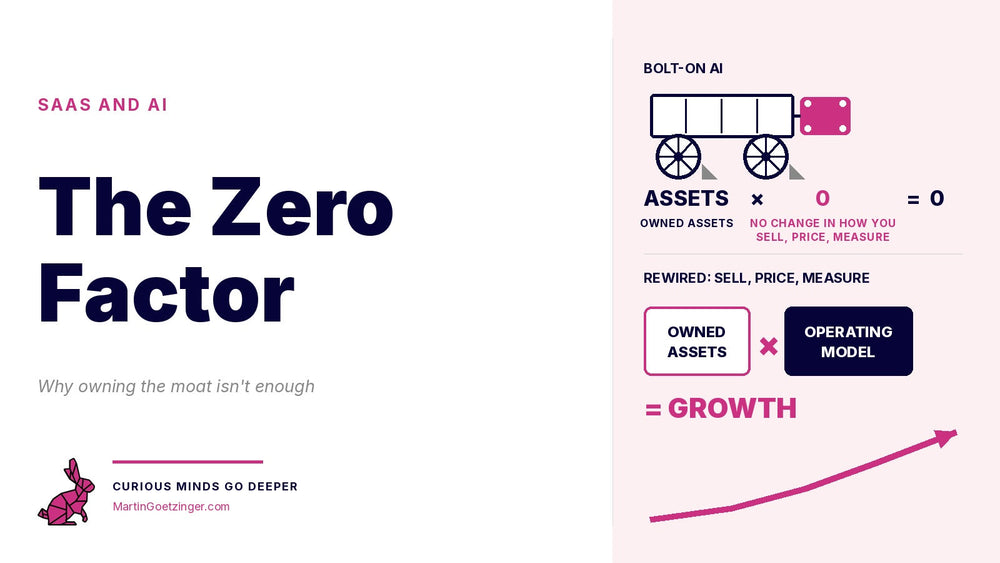
- The Zero Factor: owned assets and operating change multiply, so either at zero gets nothing.
- Usage is the new ARR only if someone with judgment decides which usage counts.
Contents
On October 22, Shane Hegde, the CEO of Air, posted a long piece on X about how his creative-asset company stopped feeling like what one of his board members called "kind of a mid SaaS category." Air had spent most of a decade building software for organizing and sharing creative work. In 2026 it bolted AI onto all of it, from semantic search to more than 50 generative models and agents. Then, in Hegde's words, "…not much happened."
I read that line twice, because Air had everything a moat is supposed to provide. It had embedded workflows and more than 3,000 customers, many of them with Air for over five years.
A motor bolted onto a wagon
That first phase is a carriage maker bolting a motor onto a wagon. The product got new parts, and nothing about how Air sold, priced or measured itself moved. In my piece on the carriage trade, I described the Studebaker Test: a vendor survives a substitution wave only to the extent it owns something the substitute still has to pass through. (Also read: Is AI Doing to SaaS What the Car Did to Carriage Makers?) Bolt-on Air failed it. Its assets sat under a product customers used the same way they always had.
Studebaker itself didn't survive on its dealers alone. It built wagons and cars side by side from 1902 to 1920. Before it could build a competitive car, it bought a third of a Detroit startup, E-M-F, and sold that company's cars through its own dealers. It changed what it sold and how it ran, and the dealer network is what made that change pay.
Air's Studebaker move
The way Hegde tells it, Air's turn came from how the company sold, priced and measured itself. Air invented a unit called Action Credit Units, priced every AI action in the product, and moved the whole company off monthly net new ARR as its main number. Marketing sells ACUs, sales closes ACUs, and a daily ACU summary lands in an #announcements channel at 9 AM, where people wait for the graph. Every new contract and renewal came with a credit allotment and overage rates, no opt-out. CSMs became forward-deployed engineers with adoption quotas. The double diamond product process was deleted, and engineers now work ahead of design.
The results, all self-reported by Hegde: ACUs up 15x over five months, 12x more monthly product improvements from a smaller team, and over the last year net new ARR tripled and the growth rate doubled. He gives no starting numbers. He does say Air was growing more than 50 percent a year when 2026 began. Doubling that means growing more than 100 percent a year, which is a company more than doubling in size annually. That's a big claim, and the post doesn't show the math behind it.

I've started calling the pattern The Zero Factor: owned assets and the way a company sells, prices and measures multiply instead of adding, so a company with plenty of one and none of the other gets nothing from either. In July I argued that the moat is whatever a free, perfect model can't absorb: data, trust, embedded workflows, distribution, judgment. (Also read: What Survives When AI Becomes a Commodity) That list is necessary. The change in how you sell, price and measure is what turns it into growth.

A big incumbent with a deep moat and an ARR-era operating model is in a worse spot than a smaller one, because the moat makes the old way feel safe. SaaS isn't dead. The way SaaS companies were run, a quarterly ARR number and a renewal team protecting it, is far more fragile than the software.
Usage can compound, and so can dysfunction
Usage has its own trap. In the org design piece I wrote that capability amplifies whatever it touches, including dysfunction, and a usage graph is a capability too. Tie every job to ACUs and you will get ACUs. A 15x spike from an undisclosed base can't tell anyone whether customers are getting daily value or burning credits they already paid for on variations nobody opens.
Hegde knows this; he writes that usage "may spike for a day" and that durable fit comes from habitual daily touchpoints. But a vendor paid on consumption is a taxi meter. The meter rewards every extra mile, and the passenger only wants to arrive. On a short, familiar trip the two agree. In a city the passenger doesn't know, the meter keeps running and the destination gets no closer.
So "usage is the new ARR" only holds if someone with judgment decides which usage counts, on the customer side as much as the vendor's. In January I wrote that the next industrial era would be about extracting value from infrastructure we'd already built, and that it would keep asking "Efficient for whom?" (Also read: The Fifth Industrial Revolution) Usage raises the same question. Who is this usage for? Judgment answers it. Judgment was also on my moat list in July.
The vendor as org designer
MIT's NANDA research reported in 2025 that 95 percent of enterprise generative AI pilots showed little measurable impact. Customers mostly never rewire their own factories, so a vendor that sends forward-deployed engineers in to do some of the rewiring is selling something closer to org design than software. (Also read: Enterprise AI Is an Organizational Design Problem in Disguise) That works, and it carries a conflict, because the person helping redesign your team gets paid when you consume more. A buyer who hands its org design to a vendor's adoption quota has outsourced the judgment that decides which usage counts.
One post on X can't show whether Air's graph is compounding value or compounding activity. It does show that Air's growth came from changing how it sold, priced and measured. For incumbents, that change is the hard part.
Key Takeaways
- Air's first AI phase was a motor bolted onto a wagon: new features on the old product, with no change in how it sold, priced or measured, and in its CEO's words "not much happened."
- Studebaker survived the car by changing what it sold and how it ran, building wagons and cars side by side from 1902 to 1920 and selling E-M-F's cars through its own dealers. The dealer network made that change pay.
- Air's Studebaker move was Action Credit Units: usage pricing at every renewal, every job tied to ACUs, CSMs turned into forward-deployed engineers with adoption quotas.
- The Zero Factor: owned assets and the way a company sells, prices and measures multiply, so either one at zero produces nothing.
- A vendor paid on consumption gains from any usage while a buyer gains only from usage that changes outcomes, so "usage is the new ARR" needs someone with judgment deciding which usage counts. Air's figures are self-reported by its CEO on X with no starting numbers.
FAQ
What is The Zero Factor?
The Zero Factor is the idea that a company's owned assets and the way it sells, prices and measures multiply rather than add. Data, trust and embedded workflows are necessary. Changing how the company sells, prices and measures is what turns them into growth, and if either is near zero the result is near zero.
How does Air's story map to the Studebaker Test?
Air's bolt-on AI phase was a carriage maker putting a motor on a wagon, and it failed the test. Its later shift to Action Credit Units, usage pricing and adoption quotas was its Studebaker move, the equivalent of Studebaker selling E-M-F's cars through its dealers while still building wagons.
What are Action Credit Units at Air?
According to Air CEO Shane Hegde, Action Credit Units are a metric Air created to price every AI action in its product. He says every job at the company now connects to ACUs and that new contracts and renewals include a credit allotment with overage rates.
About the Author
Martin Goetzinger has spent his career in enterprise software sales, helping large organizations such as Apple, Microsoft, and Verizon connect data, insight, and action. His work focuses on transforming how businesses measure success and create customer value through technology.
Outside the enterprise world, he writes about the five forces he believes are reshaping everything: AI, blockchain, energy, personalized health, and robotics. Not from a purely technical lens, but from a human one as to how these technologies will redefine work, wealth, and well-being.
He is based in the U.S. and publishes at www.MartinGoetzinger.com.
Disclaimer
The views expressed in this article are the personal opinions of the author and are provided for informational and educational purposes only. Nothing in this article constitutes investment advice, financial advice, legal advice, or any other form of professional advice. Do not make investment or financial decisions based on the content of this article. Always consult a qualified professional before making decisions that affect your finances, business, or livelihood.