
By Martin Goetzinger, Enterprise Account Executive at Adobe
Published
In brief
Personal AI agents now shop, compare and book on their customers' behalf, while most brands still personalize only for the human who never shows up. Using a Chicago hotel booking, this piece shows what changes when the store sells to the agent, why nobody inside the company owns that experience, and where brands and agent makers can build it together.
Contents
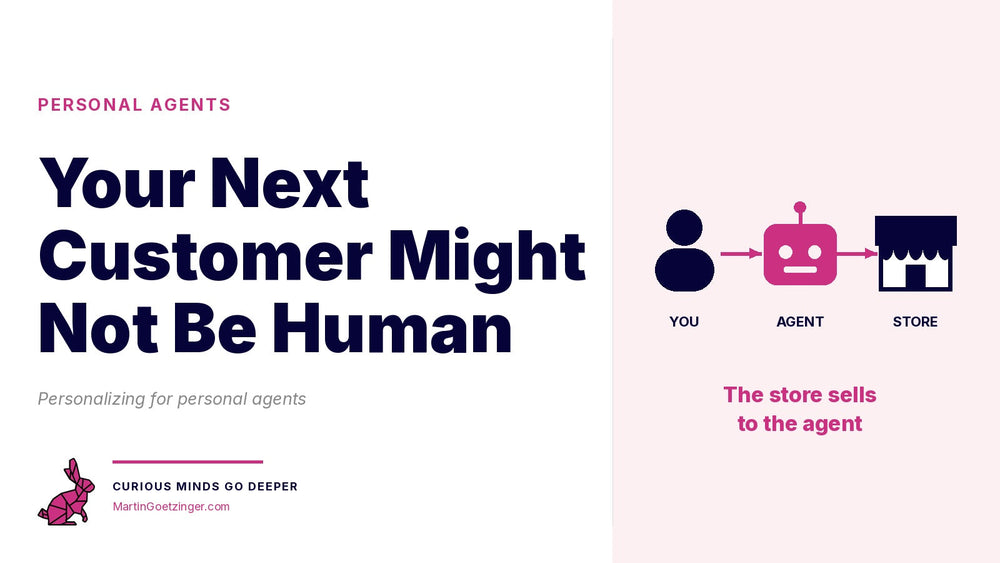
Brands have poured money and talent into personalizing digital experiences for people. Websites recognize returning visitors, apps remember preferences, and marketing platforms predict what someone wants next, all on the assumption that the person looking at the screen is the person making the decision.
A personal shopper walks the floor alone with a client's list, budget and opinions. The window displays do little for that shopper, who is reading tags, checking return policies and holding everything up against what the client asked for. The store is selling to the shopper, and the client only sees what makes it back.
Personal AI agents are giving every customer a personal shopper. Meta's Muse books travel and fills out forms, checking with the person before it buys anything. Instinct takes requests by text or call and uses a computer the way a person does to book a train or order groceries. I use Grok Bot from SpaceXAI, formerly xAI, whose agents sign into apps and websites from their own cloud computer and come back when something needs approval.
So what does personalization look like when the customer sends someone else to shop?
Every digital storefront is built for the client walking in
Websites run on imagery, banners and staged page flows, and personalization engines use behavior, identity and purchase history to decide what a visitor sees. An agent skips all of it. It visits several sites, reads the product information, weighs the options against what it knows about the person and returns with a recommendation or a finished transaction, so the customer never has to see the brand's website, whether the business is travel, banking, healthcare or telecom. (Also read: Your Marketing Stack Is Talking to Humans But AI Agents Are the Ones Listening)
The hotel in Chicago is selling to the agent
A customer asks their agent to find a hotel in Chicago next month. They care about location, loyalty benefits, room size, cancellation flexibility and price, and they prefer one hotel brand when the overall value is comparable.
The promotional banner does nothing here, and the polished landing page goes unseen. A hotel can win a guest's loyalty and still lose the booking, because the brand preference only counts when value is comparable, and the agent can only compare what it can read and verify: availability, the real price, which loyalty benefits apply to this guest, the cancellation terms and whatever sets the property apart. A plainly written cancellation policy does more selling than the hero image.

Personalization needs a second audience, where the brand chooses which information, offers and capabilities to make available to an agent acting for a known customer. Last year I called this discipline Bot Customer Experience (BCX): designing interactions for non-human users like bots, agents and AI systems, because each one is a proxy for human intent. For a brand, that means putting the whole value proposition in a form an agent can verify and act on, which goes further than making content readable by AI. (Also read: Introducing the Bot Customer Experience (BCX) Field)
Four problems brands have not had to solve before
The first is communicating value. Marketing leans on emotion and visual storytelling, while the agent weighs the underlying offer against alternatives, so product attributes, policies, loyalty benefits and reviews have to be verifiable or the differentiator doesn't exist.
The second cuts against how brands use their own customer data. The agent knows more about the customer than the brand does, even for the brand's most loyal guests. It knows this person values convenience over price and always books flexible rates, across every brand they use. Delivering relevance without that context turns personalization into a question of identity, consent and secure preference exchange.
The third is the relationship. When the agent handles discovery and the transaction, the brand loses the direct moments that built loyalty, and the agent becomes the customer's interface to every brand. Brands now earn trust twice, once from the human and once from the agent representing them.
The fourth is measurement. Analytics count visits, clicks and conversions, yet an agent evaluates ten hotels and brings back two, and the eight that lost never learn why. Brands need to see how agents discover and recommend them, and tell an agent doing research from one authorized to book. The funnel goes dark right where the decision gets made, the Proxy Collapse reaching the purchase itself. (Also read: The Proxy Collapse: When Web Traffic Stops Being Human)
BCX has no owner on the org chart
Each problem lands on a different team. Brand owns the creative, loyalty owns the program, legal writes the cancellation terms and IT runs the integrations, so nobody owns what the agent sees. That is the Unowned Door again, now showing up after the agent is inside. (Also read: Good Bots, Bad Bots: Who Owns Your Front Door?)

Incentives make it worse. A marketing team paid on traffic gets no credit for a booking made without a page view, and a loyalty team measured on app logins has little reason to expose member benefits to software. Until one executive is accountable for how the brand performs when an agent is choosing, every team keeps optimizing for the client who no longer walks in.
Brands and agent makers want the same thing
The reflex is to treat agents as a disruption to react to, yet brands and agent makers have more in common than in conflict. Agents need accurate information, clear policies and predictable ways to finish a task, and brands need their value understood and their customer relationships protected. Neither side gets there alone, which makes this an opportunity for co-innovation.
Picture the hotel brand working with agent makers on a consistent way to share availability, loyalty benefits and booking conditions, or a bank letting customers' agents compare products against their priorities without exposing more personal data than the comparison needs. That work settles how an agent identifies itself and proves it is authorized to act for the customer, how preferences and permissions travel with it, what information gets structured for evaluation, how offers get personalized without compromising privacy, and who is accountable when an agent books the wrong room. Those are customer experience questions before they are integration questions.
The first brands to serve the agent become its default
People will keep visiting websites and talking to salespeople, but designing every interaction for a human on the other side gets harder to defend each month, and a chatbot on the homepage doesn't answer it. The advantage goes to brands that shape this now. An agent that finds clean, current answers from one hotel brand and guesswork from the rest learns where to look first, the same way a personal shopper builds a short list of stores that never waste the client's time. The next step in personalization is knowing how to serve the agent that represents the customer, because the customer isn't always the one doing the browsing.
Key Takeaways
- Personal agents shop on the customer's behalf, so brands now personalize for a second audience: the software acting for the person.
- A hotel can hold a guest's loyalty and still lose the booking when the agent can't verify its price, benefits and cancellation terms.
- The agent knows the customer's priorities across every brand, which turns personalization into a question of identity, consent and secure preference exchange.
- Bot Customer Experience has no natural owner, because creative, loyalty, legal and IT each hold a piece and none is paid on how the brand performs with agents.
- Brands and agent makers share an interest in accurate, verifiable information, which makes agent identity, authorization and accountability work they can do together.
FAQ
What is Bot Customer Experience (BCX)?
Bot Customer Experience is the practice of designing interactions for non-human users like bots, agents and AI systems, because each one is a proxy for human intent. For a brand, it means giving an agent acting for a customer information, offers and policies it can verify and act on.
How is personalizing for an AI agent different from personalizing for a person?
A person responds to imagery, banners and page flows, while an agent compares verifiable facts such as availability, price, loyalty benefits and policies against the preferences it holds for its customer. The brand decides what to make available to the agent instead of what to display to a visitor.
Who should own Bot Customer Experience inside a company?
One executive accountable for how the brand performs when an agent is choosing. Today the pieces sit with brand, loyalty, legal and IT, and none of them is measured on agent outcomes.
Sources and References
- The Unowned Door, a framework by Martin Goetzinger (My Idea Frameworks)
- The Proxy Collapse, a framework by Martin Goetzinger (My Idea Frameworks)
- Bot Customer Experience (BCX), a framework by Martin Goetzinger (My Idea Frameworks)
- Introducing Muse, about.fb.com
- Instinct, instinct.com
- Introducing Grok Bot, x.ai
- SpaceXAI's Grok Bot turns agents into persistent digital coworkers, venturebeat.com
About the Author
Martin Goetzinger has spent his career in enterprise software sales, helping large organizations such as Apple, Microsoft, and Verizon connect data, insight, and action. His work focuses on transforming how businesses measure success and create customer value through technology.
Outside the enterprise world, he writes about the five forces he believes are reshaping everything: AI, blockchain, energy, personalized health, and robotics. Not from a purely technical lens, but from a human one as to how these technologies will redefine work, wealth, and well-being.
He is based in the U.S. and publishes at www.MartinGoetzinger.com.
Disclaimer
The views expressed in this article are the personal opinions of the author and are provided for informational and educational purposes only. Nothing in this article constitutes investment advice, financial advice, legal advice, or any other form of professional advice. Do not make investment or financial decisions based on the content of this article. Always consult a qualified professional before making decisions that affect your finances, business, or livelihood.